
During the post-COVID public health emergency unwinding, Medicaid state agencies faced a mountain of renewals and deep concern that procedural hurdles, systems challenges and operational load would result in significant coverage loss and backlogs. States had to react, adopting flexibilities offered by the Centers of Medicare and Medicaid Services (CMS) and fixing systems while renewals were already underway, and often learning what wasn’t working only after people had lost coverage. Of the more than 25 million people disenrolled, 69% lost coverage for paperwork or procedural reasons rather than a finding that they were ineligible. A new CMS offering lets states do things differently as another major shift looms—Medicaid work requirements. If done right, taking advantage of this option is an opportunity for states to iteratively improve their service delivery before people lose coverage.
What is the Medicaid “hold harmless” period?
States are currently racing to finish system updates and communications and to coordinate with navigators, providers and managed care plans to comply with the January 1 implementation deadline. As the deadline looms, CMS recognized how hard it is to implement and communicate a significant eligibility change in a short period of time. On November 13, it announced that states can opt into a six-month “hold harmless” period to shore up their plans and systems, while still evaluating all relevant applications and renewals for the new requirements, just without enforcing them. While many states may use this period to complete planned work or take on additional improvements that they couldn’t complete by December 31, CMS frames the period as a chance to learn:
“Doing so will let states test and refine their systems and processes before enforcement begins, supporting a successful launch of the community engagement requirement. This will also provide states the opportunity to learn from the early months of implementation to identify and address workforce training needs and improve the applicant and beneficiary experience before enforcement begins.”
Government agencies rarely get the time or opportunity to “soft launch” new requirements, monitor program performance, and iteratively improve before the requirements are enforced. New policies require state agencies to react quickly, determine what service delivery changes are required, execute on those requirements, and then start enforcing the new policy. There’s rarely time to review outcomes and improve before the next policy hits, and there’s almost never a chance to launch service delivery changes and learn from their performance before enforcement begins.
For states like Louisiana and Connecticut which have already announced their intent to opt in to the “hold harmless” period, the six month period will provide them rich data about what’s working and what could be improved from call center wait times to processing backlog size to non-response rates. This is a rare opportunity for these states to apply a test-and-learn, iterative, data-driven approach to their work requirements implementation each month. Here’s how, in five steps, based on how our Medicaid Delivery Innovation Initiative (MDII) team partners with states to improve targeted outcomes.
Five steps for states to test and fix their Medicaid work requirements implementation
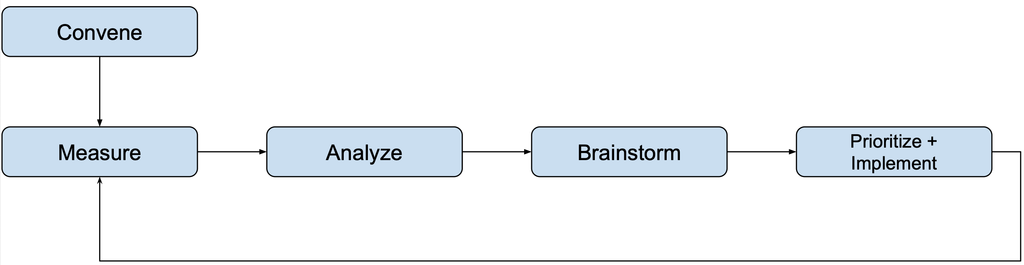
Convene
To get started, state Medicaid agency leadership should convene a cross-functional taskforce with key members of tech, communications, policy, operations, and vendor staff to meet regularly to assess work requirements implementation performance. An initial meeting might focus on setting expectations, meeting cadence, and assigning responsibilities. Staff should understand how urgently leadership expects them to move, and the group should work together to eliminate barriers to fast iteration. For example, an eligibility system might normally release changes only four times a year, but tech and vendor staff should determine what it would take to release monthly to accelerate learning and improvement. Similarly, reports of key metrics might lag several weeks behind, but reporting staff should be tasked with identifying ways to report closer to real time.
Measure
Understanding how the state’s work requirements implementation is performing starts with the right data. Our work requirements measurements guide has a comprehensive set of measures states might want to monitor, but starting with a few key measures can surface problems early:
- Ex parte rates for expansion adults: Every member the state can verify automatically is one who never has to respond to a notice, and one whose renewal a caseworker doesn’t have to review. If fewer expansion adults are making it through automated work requirements verification than expected, there may be a mismatch between system implementation and policy intent.
- Call center hold times: Calls rise when notices confuse people or online tools fall short, so hold times point to where members are getting stuck. Long waits can also cause members to miss response deadlines.
- Application rates across modalities: A drop in application rates may point to resident confusion or other friction, leading people to self-select out of benefits they may qualify for. Comparing across modalities (online, mail, in person) can show which channels need the most attention.
- Renewal and application processing times: New verifications will require additional time from caseworkers processing renewals and applications. Rising processing times signal a backlog forming, and might highlight a need to focus on automation, training, or caseworker-facing system efficiencies.
- Non-response rates per notice or request for expansion adults: States will be communicating many new requests to applicants and beneficiaries, and knowing which go unanswered most often shows where clearer, plainer language is needed.
- Qualitative feedback from eligibility staff and navigators: Because they talk with residents every day, eligibility workers and navigators know where members are confused and can provide insight into what’s behind a quantitative metric.
Some measures may already be in place, while others may require new reporting. In either case, data often requires refinement. Examine it as soon as possible, even before January, to help identify issues with reports so data is accurate and useful. Designating a dedicated lead who understands the program and its systems to oversee data and reporting can help drive measurement initiatives and refine data accuracy.
In addition to forward-looking data and measurement, states should consider gathering key metrics from 2026 for the same populations to compare year-over-year performance for the same month given seasonal beneficiary population differences.
Analyze
Once data is available, taskforce members should gather to examine it together. Key moments for analyzing data each month include:
- After ex parte renewals have been attempted
- Within the first week of the month to assess application rates and call center volume
- At the end of the month to assess non-response rates and app/renewal outcomes
What trends are concerning? What next steps would help shed light on what’s contributing to those trends? The table below lists common trends and questions to start with.
| Observed trend | Things to consider |
| Ex parte rates decreasing |
|
| Call center hold times increasing |
|
| Application rates are decreasing |
|
| Renewal or application processing times are increasing |
|
| Non-response rates are increasing |
|
Brainstorm
Once a trend is understood, the taskforce should brainstorm solutions. While the goal is to find solutions with near-term impact, setting implementation effort aside at first can surface surprising options that turn out to be quick to build, along with promising items for the longer-term roadmap.
Further, it’s important to look beyond work requirements and focus on what will improve the outcome leadership is seeking. For example, if call center hold times climb after new work requirements notices go out, the obvious fix might be a clearer notice or a new FAQ about exemptions. But a look at top call drivers might show that many callers just want to know whether the agency received the documents they sent, a question that isn’t work requirements specific. An email or text message confirming receipt, sent for every received document, could cut those calls and free up call center staff to help members with more complex work requirements questions.
Prioritize and Implement
Multiple solutions to mitigate a particular trend may emerge through brainstorming. Scoring each idea on expected impact and effort can show which to prioritize for rapid implementation. Based on the data available, which will have the largest potential impact on the measure you’re trying to improve? And which can be put in place soonest? Leave the brainstorming session with marching orders for the owners of each prioritized intervention to make the solutions real. Leadership should work with their taskforce to clear barriers to implementation as soon as possible. Interventions affecting renewals, for example, should be put in place prior to the initiation of the next monthly cohort’s renewals. Before anything launches, its owner should define what success looks like and which measure will show it.
Then repeat
Once a proposed improvement is implemented, it’s time to measure once again. What data would tell the taskforce if the change that was put in place is having the intended impact? The team should measure and reconvene to review available data, and analyze whether further refinement is needed, another intervention is needed, or whether a different measure now deserves attention.
Our MDII team puts this methodology into practice alongside state Medicaid agencies in short sprints to identify opportunities to improve ex parte rates, reduce procedural termination, and improve caseworker efficiency. In one state, in a matter of weeks, we were able to identify opportunities to improve the ex parte rate by over 20 percentage points. States now have the opportunity to execute this playbook multiple times in the six month period to achieve even greater refinement.
Iterative improvement can become a habit that changes the way an agency operates over the long term, but the “hold harmless” period offers a particularly urgent opportunity to do so before any beneficiary loses coverage. States that want the period to start January 1 must notify CMS by December 11, so the time to convene a taskforce is now. Let’s get to work.
The Medicaid Delivery Innovation Initiative (MDII) team provides no-cost technical assistance and can partner with states to execute this test-and-learn model. State Medicaid leaders can complete the statement of interest form here.